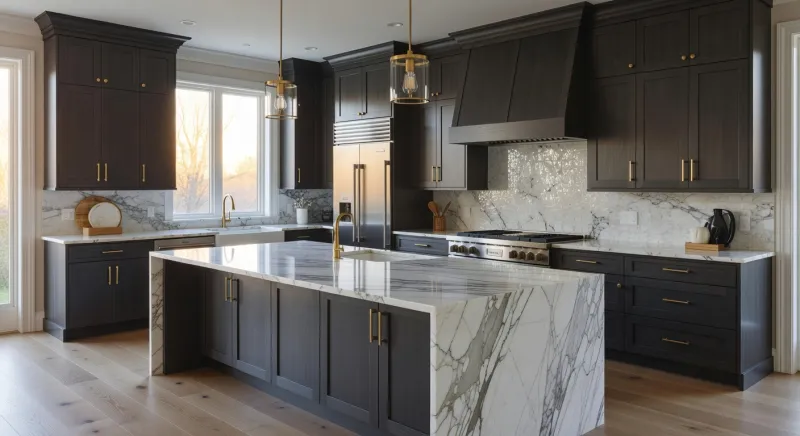
Walk into a well-designed kitchen and something quietly tells you where to stand, where to gather, and where to get out of the cook's way. There are no velvet ropes, no signs, no walls dividing prep space from conversation space. Yet the message is unmistakable. This is the power of kitchen spatial zoning through ceiling height design — a set of architectural moves that carve a single room into multiple distinct territories, each with its own mood, its own purpose, and its own unspoken rules.
The concept is sometimes called the "room within a room." Rather than building physical partitions, designers use changes in ceiling plane, shifts in flooring or cladding material, and transitions in lighting quality to signal: this area is for work, that area is for people. Understanding how it works gives you a new way to read any kitchen you walk into — and a sharper brief if you're planning one yourself.
Why Spatial Zones Matter in an Open Kitchen
The modern kitchen has absorbed functions that once lived in separate rooms. It is simultaneously a professional production space, a homework desk, a cocktail bar, and the social heart of the home. Without some form of spatial logic, these competing demands create a chaotic environment where guests feel awkward hovering near a hot stove and the cook feels constantly on display.
Walls solve this problem bluntly — but they also kill light, limit conversation, and contradict the entire premise of open-plan living. Spatial zoning through architectural and material cues achieves the same psychological separation without closing anything off. Each zone reads as its own environment, yet the spaces flow continuously into one another.
Ceiling Height as the Primary Signal
Of all the tools available to a kitchen designer, ceiling height is arguably the most powerful. Human beings are acutely sensitive to the volume of space above their heads — it influences how exposed or sheltered we feel, how formal or relaxed the atmosphere seems, and how much cognitive energy we associate with a particular spot.
Lowering the Ceiling Over the Work Zone
A dropped ceiling plane directly over a kitchen island or a run of cabinetry does something counterintuitive: it actually makes that area feel more purposeful and contained. A ceiling that descends to, say, just above the extraction hood draws the eye downward and inward, concentrating attention on the task at hand. It creates what architects call a compression — a tightening of space that heightens focus and energy. Restaurants exploit this constantly in their kitchen pass-throughs, and residential designers have borrowed the principle for domestic prep zones.
This dropped plane can be expressed in multiple ways: a structural soffit, a timber-clad panel suspended between ceiling and cabinetry, a run of pendant lights hung low enough that they effectively form a visual ceiling of their own, or an integrated lighting coffer. The material doesn't have to match the surrounding ceiling — in fact, it works better when it doesn't.
Raising the Ceiling Over Social Areas
Where you want people to linger — a kitchen dining table, a breakfast bar, a casual seating nook — the spatial logic inverts. A higher or vaulted ceiling above these areas signals release and openness. The volume expands, breathing room appears, and the atmosphere shifts from concentrated activity to relaxed sociability. If a kitchen occupies a single large room with a uniform ceiling, a designer can suggest this upward expansion by omitting the dropped elements present over the work zone, allowing contrast to do the work.
In a room with a genuinely vaulted or double-height ceiling, the social area almost selects itself — people naturally gravitate toward the tallest, most expansive part of the volume. Smart kitchen planning aligns the seating or gathering space with that existing architectural generosity.
Material Shifts as Invisible Walls
Ceiling height establishes volume; material transitions establish ground. The shift from one flooring material to another is one of the oldest architectural devices for defining territory, and in a kitchen it remains highly effective precisely because it requires no physical barrier.
Flooring as Zone Marker
A common move is to run a hardwood or stone floor continuously through an open-plan space, then introduce large-format tile, polished concrete, or a contrasting material beneath the kitchen work area. The change in underfoot texture and visual character tells your feet — before your brain consciously registers it — that you have crossed into a different kind of space. The kitchen zone reads as a defined insert within the larger room, contained without being enclosed.
The boundary line itself matters. A sharp, clean joint between materials reads as deliberate and architectural. A transition strip or threshold piece can reinforce this, borrowing the grammar of a doorway without the door. Some designers deliberately align this material boundary with an overhead element — a beam, a change in ceiling finish, a pendant light cluster — so that the zone is defined on both the horizontal and vertical planes simultaneously.
Wall and Splashback Cladding as Vertical Territory
The same logic applies vertically. A bold splashback material — zellige tile, brushed steel, fluted glass, handmade ceramic — that runs from countertop to ceiling not only protects the wall but stakes out the kitchen's claim on that area of the room. It creates a backdrop that belongs exclusively to the functional zone, visually differentiating it from the painted or plastered walls of the adjacent living or dining area.
When this cladding wraps around a corner or continues across the underside of a dropped ceiling panel, it strengthens the room-within-a-room effect considerably. The kitchen begins to feel like a fully conceived object inserted into the larger space, rather than just a row of cabinets pushed against a wall.
Lighting Transitions: The Most Flexible Zone-Maker
If ceiling height and materials are the fixed architecture of spatial zoning, lighting is its adjustable layer. Lighting transitions can reinforce zones established by structure and material, or they can do much of the zone-defining work independently — making them particularly valuable in kitchens where the architecture itself is relatively neutral.
Task Lighting Defines the Work Zone
Concentrated, directional light over prep surfaces and cooking areas serves both a practical and a spatial function. Functionally, it delivers the illumination needed for precise knife work and accurate color judgment when cooking. Spatially, it pools brightness into the work zone, distinguishing it from the surrounding space in a way that is immediately legible even in peripheral vision.
The fixtures themselves contribute to this zoning. A series of pendant lights hung in a disciplined line above an island creates a visual ceiling — a luminous horizontal plane that reinforces the island's identity as a defined territory. The pendants don't need to be at the same height as a structural soffit to achieve this effect; the repetition and alignment are enough.
Ambient and Accent Lighting Defines the Social Zone
In the social or dining area adjacent to the kitchen, the quality of light should change perceptibly. Warmer color temperatures, lower overall intensity, and a higher proportion of indirect or reflected light all signal a shift from productive to convivial. A single statement pendant over a kitchen table — different in character from the task pendants over the island — acts as a zone-defining device even in the absence of any structural or material boundary.
Layered lighting systems, where ceiling-recessed downlights, under-cabinet strips, pendant fixtures, and accent lights all sit on separate circuits, allow a kitchen to shift its zoning emphasis entirely through lighting alone. The same room can feel like a focused cooking environment during meal preparation and a warm, atmospheric dining space an hour later — the zones contracting and expanding as needed.
Integrating All Three Layers: A Practical Framework
The most convincing kitchen spatial zones are those where ceiling height, material, and lighting work in concert rather than independently. Here is how that integration typically plays out across the two primary kitchen territories:
The Functional Zone
A dropped or articulated ceiling plane (expressed through a soffit, timber panel, or coffer) compresses the volume above the work surfaces. A distinct flooring material or a continuous splashback cladding defines the footprint on the horizontal and vertical planes. Task-oriented pendant fixtures or recessed directional lights reinforce the ceiling datum and concentrate brightness where work happens. The combined effect is a space that communicates: purposeful, energetic, contained.
The Social Zone
The ceiling opens — either literally higher or simply free of the dropped elements present over the work area. The flooring material returns to the dominant finish of the adjacent living space, dissolving the zone's boundary on one side while a change in furniture scale or a rug anchors it on the other. Lighting becomes warmer, softer, and less directional. The message shifts: relaxed, hospitable, open-ended.
Common Mistakes and How to Avoid Them
The room-within-a-room concept can misfire if the zone transitions are either too subtle or too aggressive. Transitions that are barely perceptible — a slight change in floor tone, a modest ceiling variation — fail to register as deliberate signals, and the result is a kitchen that simply looks inconsistent rather than thoughtfully layered.
Equally, transitions that are too dramatic can fragment what should feel like a coherent space. A dropped ceiling that descends aggressively low can feel oppressive rather than purposeful. A flooring material that is wildly incongruous with its surroundings can make the kitchen feel like a separate room inserted accidentally into the wrong house. The goal is contrast that reads as considered — different enough to signal a change, harmonious enough to belong to the same design family.
Scale is the other frequent miscalibration. Spatial zoning through ceiling and material shifts works best in rooms where the overall volume is generous enough to support variation. In a small kitchen, a single dropped element can easily overwhelm the space. Here, lighting transitions and material boundaries do more of the work, with ceiling height contributing only modestly — or not at all.
Reading Any Kitchen Through This Lens
Once you understand the vocabulary — ceiling compression, material boundaries, lighting quality shifts — you start to read kitchens differently. The overhead panel in a restaurant kitchen that makes the pass feel like a separate room. The change from concrete to timber underfoot that tells you the island is where the cook works and the counter to your right is where you pour yourself a drink. The warm pendant over the table end of a long kitchen that makes dinner feel nothing like the breakfast rush in the same room.
These are not accidental effects. They are a designed language, and it is one of the more quietly sophisticated things a thoughtful kitchen can do — using the physical properties of space and material to organize human behavior without saying a word.